So, you’ve decided to put a crown on your wrist. Whether you’re celebrating a promotion, a milestone birthday, or simply the realisation that you’ve reached a stage in life where you appreciate the finer things, buying your first Rolex is a rite of passage. It is the moment a timepiece stops being a tool for telling time and starts being a landmark of your personal history.
But entering the world of Rolex can feel like walking into a high-stakes club where everyone else already knows the secret handshake. Between the cryptic model numbers, the whispers of “waitlists,” and the fluctuating market prices, the process can be daunting. This guide is designed to strip away the intimidation and help you find the Rolex that doesn’t just fit your budget but fits your life.
Why Your First Rolex Matters
Buying a Rolex is rarely a purely logical decision. If you wanted the most accurate way to tell time, you’d look at your smartphone or a ten-dollar quartz watch. You are here because of what the watch represents.
The Psychology of the Crown
There is a unique weight to a Rolex. It’s the “Crown” for a reason. For decades, this brand has been the universal shorthand for success. When you look down at your wrist and see that five-pointed coronet, it serves as a private psychological anchor. It reminds you of the hard work you put in to get there. It’s a physical manifestation of “I’ve arrived.” For many first-time buyers, the watch acts as a talisman of confidence that carries them through boardrooms, first dates, and family dinners alike.
Setting Realistic Expectations for the Modern Market
Before we dive into stainless steel and gold, we need a reality check. We are living in a market where demand for many Rolex models often exceeds supply. You cannot always walk into an Authorised Dealer in Sydney, Melbourne, Brisbane, Perth or Adelaide, point at a steel Submariner, and walk out with it the same day.
Understanding the Rolex buying process is vital. Entry-level does not mean cheap, and it does not always mean immediately available. You may need to wait, build a relationship with an Authorised Dealer, or choose the pre-owned market if you want a specific model quickly.
What Makes a Rolex “Entry-Level”?
In the Rolex universe, “entry-level” is a relative term. We aren’t talking about “budget” watches; we are talking about the gateway drugs of horology, the models that provide the most authentic Rolex experience without requiring a six-figure spend or a decade-long wait.
Price Point vs. Value Retention
For Australian buyers, many modern entry-level Rolex watches now sit around AU$11,000–AU$17,000+ at retail, depending on the model and configuration. Smaller Oyster Perpetual models, the Explorer, Air-King and some Datejust configurations are often considered realistic first Rolex options. Pre-owned and vintage watches may sometimes be found below this range, especially older, smaller or less-hyped references.
While this is a significant investment, Rolex watches are known for strong value retention when bought carefully. A well-maintained Rolex with original parts, box, papers and service history can hold its value well over time.
Versatility: The “One-Watch Collection” Concept
For your first Rolex, you want a “GADA” watch: Go Anywhere, Do Anything. You need a piece that looks as natural with a navy suit as it does with a t-shirt and jeans on a Saturday morning. An entry-level choice should be a chameleon. If you buy a gold Cellini dress watch or a precious metal Rolex Day-Date, you can’t wear it to the beach. If you buy a massive Sea-Dweller, it might not slide under a shirt cuff. The best first Rolex is the one you never feel the need to take off.
Availability and Waitlists
Some models are “entry-level” in price but “expert-level” in difficulty to acquire. A steel Rolex Daytona chronograph is technically a production watch, but you won’t get one as your first purchase. True entry-level models are those that an Authorised Dealer might actually allocate to a new customer within a reasonable timeframe, anywhere from a few weeks to a few months.
The Top Recommendations for First-Time Buyers
Now, let’s look at the heavy hitters. These four or five models represent the gold standard for anyone starting their journey.
1. The Oyster Perpetual: The Purest Entry Point
If Rolex is a religion, the Oyster Perpetual (OP) is its fundamental scripture. It is the direct descendant of the original 1926 Oyster, the world’s first waterproof wristwatch. There are no dates, no rotating bezels, and no complications, just the pure essence of timekeeping.
The Beauty of Simplicity
The OP is a masterclass in restraint. It features a clean, symmetrical dial and the iconic three-link Oyster bracelet. Because it lacks a date window (and the “Cyclops” magnifying lens), the watch has a balanced, understated aesthetic. It doesn’t scream for attention; it commands it quietly.
Size Options and Dial Colours
One reason the Rolex Oyster Perpetual is the ultimate beginner’s choice is its variety. It comes in 28mm, 31mm, 34mm, 36mm, and 41mm. Whether you have a slender wrist or a large one, there is an OP that fits perfectly. Furthermore, Rolex has experimented with vibrant dial colours recently, from “Tiffany” blue and “Celebration” motifs to classic silver and bright blue.
Why it’s the Perfect Daily Driver
The OP is the quintessential daily driver because it is robust. It features the same 904L stainless steel as the professional diving watches and a high-performance movement with a 70-hour power reserve. It is the watch you put on Monday morning and don’t think about again until Sunday night.
2. The Datejust: The Industry Icon
If you ask a child to draw a “luxury watch,” they will likely draw a Rolex Datejust. Since 1945, it has been the blueprint for the modern wristwatch. It was the first self-winding chronometer to display the date in a window on the dial.
The Most Recognisable Rolex in the World
The Datejust is the “safe” bet, but in the best way possible. It is instantly recognisable across a crowded room. If you want people to know you’re wearing a Rolex without saying a word, this is your watch.
Configuration Choices: Smooth vs. Fluted Bezel
The Datejust is a “choose your own adventure” watch. The smooth bezel is sporty, modern, and slightly more flying-under-the-radar. The fluted bezel, made of 18k white gold, is the classic Rolex look. It catches the light like a diamond and adds a level of formality to the piece.
For first-time Australian buyers who want better value, a smooth-bezel Oystersteel Datejust is usually more accessible than a fluted-bezel or two-tone configuration.
Oyster vs. Jubilee Bracelets
You also have a choice in bracelets. The Oyster bracelet is sporty and sturdy. The Jubilee bracelet, with its five-link construction, is dressier and incredibly comfortable, as the small links contour to the wrist like silk. For a first-timer, a Datejust 36 or 41 with a fluted bezel and Jubilee bracelet is the definitive Rolex experience.
3. The Explorer I: For the Minimalist Adventurer
While the Datejust is often associated with the boardroom, the Explorer is associated with mountains, exploration and understated durability. It is a tool watch in one of its most elegant forms.
A History Rooted in Tool Watch DNA
The Explorer is built to withstand extreme temperatures and rugged terrain. It features the famous “3-6-9” dial layout, which provides high legibility at a glance. There are no polished centre links here; the watch is brushed steel, meant to take a beating and look better for it.
The “Go Anywhere, Do Anything” (GADA) Factor
The Explorer is often cited by enthusiasts as the perfect “one-watch collection.” It is perhaps the most versatile watch Rolex makes. Because it is all steel and black-dialed, it is incredibly discreet. It doesn’t have the “flash” of a Datejust, making it perfect for someone who wants Rolex quality without the social baggage of a “status symbol.”
Understanding the 36mm vs. 40mm Debate
For years, the Explorer was 36mm, a classic, vintage size. Rolex recently introduced a 40mm version. If you have a larger wrist (over 7.25 inches), the 40mm provides modern presence. However, purists will always point you toward the 36mm for its historical accuracy and perfect proportions.
4. The Air-King: The Quirky Alternative
If you find the other models a bit too “traditional,” the Air-King is your wildcard. It has a long history with aviation, but the modern version is unlike anything else in the catalogue.
A Unique Connection to Aviation
The Air-King was created to honour the RAF pilots of World War II. It’s a tribute to the pioneers of flight, and that spirit of adventure is baked into the design.
Distinctive Dial Design and Colour Accents
The modern Air-King (Ref. 126900) features a black dial with large “3-6-9” numerals and a prominent minute scale for navigational timing. What sets it apart are the splashes of colour: a green “Rolex” logo and a yellow crown. It’s the only Rolex model that uses two different colours for the branding on the dial.
Value Comparison to Other Professionals
The Air-King often sits at a slightly lower price point than the Submariner or Rolex GMT-Master II with its dual time zone complication, yet it shares the same robust case construction and movement. It’s a fantastic way to get a “Professional” series Rolex that feels a bit more “indie” and unique.
5. The Submariner: The Ultimate Aspirational First Choice
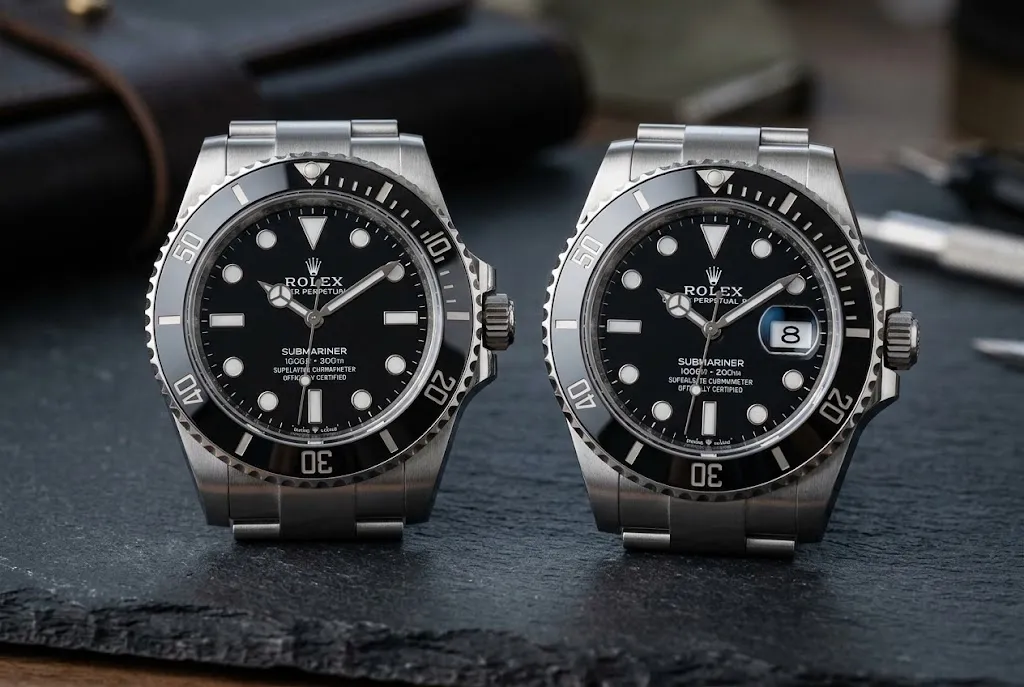
We have to talk about the Rolex Submariner. For many, it isn’t just the first Rolex they want; it’s the only watch they want. It is the most famous dive watch in history, popularised by James Bond and countless explorers.
Why This Is the “Final Boss” of Entry-Level
The Submariner is the hardest “entry-level” watch to get. It is technically a professional diver’s tool, water-resistant to 300 meters. Its ceramic Cerachrom bezel and Glidelock clasp (which allows you to adjust the bracelet size without tools) make it a marvel of engineering.
Date vs. No-Date: Which Should You Choose?
The “No-Date” Submariner (Ref. 124060) is the purist’s choice, symmetrical and true to the original 1953 design. The Submariner Date (Ref. 126610LN) is more practical for daily use. If you can get your hands on either at retail, you’ve essentially won the lottery.
Navigating the Premium Price Gap
Because demand for the Submariner is so high, the “grey market” (resale) price is often 30-50% higher than the retail price. For a first-time buyer, this is the crossroads: do you wait 12-24 months at a dealer, or do you pay the premium now? If this is your dream watch, sometimes paying the premium is worth the years of enjoyment you get in return.
Crucial Factors to Consider Before You Buy
Before you swipe your card, you need to understand the mechanics of the purchase.
New vs. Pre-Owned: Pros and Cons
Buying new from an Authorised Dealer gives you the full experience: your name on the warranty card, a fresh 5-year guarantee, and the smell of a new box. However, buying pre-owned allows you to access discontinued models, a specific vintage Rolex, or “neo-vintage” pieces that might have more character. Just be prepared to do your homework to ensure authenticity.
The Importance of “Box and Papers”
In the Rolex world, “Box and Papers” (the original packaging and warranty card) are the watch’s birth certificate. A watch with its full set is generally worth 10-15% more than a “naked” watch. For your first purchase, always aim for a full set. It’s vital for future resale and provides peace of mind.
Understanding Movement and Power Reserve
Most modern Rolexes now feature the 32xx series movements. These are mechanical marvels with “Chronygy” escapements and a 70-hour power reserve. This means you can take the watch off on Friday night, leave it on your nightstand, and it will still be ticking on Monday morning.
How to Navigate the Authorised Dealer (AD) Experience
Walking into a Rolex boutique can feel like an audition. Here’s how to handle it.
Building a Relationship Without a Purchase History
Be human. Don’t walk in and immediately ask, “Do you have a Submariner?” You’ll be shown the door. Instead, go in and talk about why you want the watch. Is it for a graduation? A wedding? Sales associates are gatekeepers, but they are also people. They would much rather sell a watch to someone who will cherish it than to a flipper looking to make a quick buck.
Questions to Ask Your Sales Associate
- “What is the typical timeframe for an Oyster Perpetual in this size?”
- “Can I try on an exhibition model to see how it fits my wrist?”
- “Do you have any advice for a first-time collector starting out?” Showing interest in the brand’s history goes a long way.
Avoiding the Pitfalls of the Grey Market
If you decide to go the grey market route to avoid the wait, follow the golden rule: “Buy the seller, not the watch.” Only buy from established businesses with thousands of positive reviews. If a deal on a Rolex seems too good to be true, it is 100% a fake.
Maintenance and Long-Term Ownership
A Rolex is an heirloom, but only if you take care of it.
Servicing Intervals and Costs
Rolex generally recommends servicing based on the model, age and usage pattern. Many modern Rolex watches may only need servicing roughly every 10 years if they are running well, while older or heavily worn pieces may need attention sooner.
A full service may include disassembly, cleaning, lubrication, regulation, seal replacement, pressure testing and replacement of worn parts.
For Australian buyers, a Rolex service can often cost around AU$1,000–AU$1,800+ depending on the model, condition and whether additional parts or bracelet repairs are required. Vintage watches, complicated models or watches with moisture damage may cost more.
Budget for servicing the same way you would budget for maintaining a car. A Rolex is durable, but it is still a mechanical object with oils, seals and moving parts.
Insuring Your Investment
Once you buy your Rolex, consider insuring it immediately. In Australia, this may involve adding the watch to your home and contents policy as a specified item or using a specialist jewellery and watch insurance provider.
Make sure the policy covers theft, accidental loss and damage outside the home, not just burglary from your residence. A watch that is only covered inside your home may not be protected while you are travelling, commuting or wearing it daily.
Keep your receipt, valuation, serial number, photos, box and papers in a safe place. These records can be important for insurance, resale and future servicing.
Final Thoughts: Buy the Watch, Not the Hype
It is easy to get caught up in what “the internet” says is the best Rolex. You’ll hear people obsessing over resale values, “investment-grade” pieces, and waitlist strategies.
My advice? Ignore them.
The best Rolex for a first-time buyer is the one that makes you smile when you check the time. Whether it’s a simple 34mm Oyster Perpetual or a beefy Submariner, the “right” watch is the one that feels like an extension of your personality. A Rolex is more than a timepiece; it’s a companion for the next fifty years of your life. Choose the one you want to grow old with.
Buying your first Rolex should feel exciting, not overwhelming. Browse Swiss Watch Dealer’s Rolex collection and get expert guidance from a trusted Australian luxury watch dealer offering authenticity checks, warranty support, and secure insured delivery.