Deciding between a Tudor and a Rolex can feel like choosing between two prized jewels from the same royal lineage in Switzerland, the spiritual home of the Swiss watch industry. Both brands represent the pinnacle of Swiss watchmaking, boasting incredible heritage, precision, and craftsmanship. Yet, they cater to distinct desires and tell different stories on the wrist. If you’re standing at this fascinating crossroads, weighing the nuances of these horological titans, you’re in the right place.
This isn’t just about comparing features; it’s about understanding the soul of each brand and discovering which one truly resonates with your own journey.
The Enduring Legacy of Two Watchmaking Giants
Imagine a grand old workshop, steeped in history, where precision timekeeping is an everyday ritual. That’s the world of Rolex and, by extension, Tudor. For decades, these names have been synonymous with innovation, reliability, and an almost mythical aura of luxury.
They’ve adorned the wrists of explorers, presidents, artists, and everyday dreamers, marking moments of triumph and quiet contemplation alike. Understanding their shared roots and divergent paths is key to appreciating their individual brilliance. It’s not a competition in the traditional sense; it’s a dynamic interplay between a revered elder statesman and its ambitious, equally talented younger kin.
The History of Tudor and Rolex

To truly grasp the essence of Tudor and Rolex, we must first journey back to their origins, to the visionary mind that linked them irrevocably. Think of it like a master chef creating a signature dish, and then, inspired by its success, crafting another, equally delicious, but with a slightly different flavour profile and an eye toward a wider audience.
Rolex: The Crown Jewel of Horology
Our story begins with Hans Wilsdorf, a German visionary who, in the early 20th century, foresaw the wristwatch becoming an indispensable tool rather than a mere trinket. In 1905, he established Wilsdorf & Davis in London, focusing on distributing high-quality movements. But Wilsdorf dreamt bigger. He wanted to create a watch that was not just accurate, but robust, waterproof, and self-winding. In 1908, he coined the name “Rolex,” a short, memorable word that could be pronounced in any language and, he believed, sounded like the winding of a watch.
Rolex’s history is a relentless march of innovation. In 1926, they introduced the Oyster case, the world’s first truly waterproof watch case, famously demonstrated by Mercedes Gleitze swimming the English Channel with a Rolex Oyster on her wrist. Then came the Perpetual rotor in 1931, the first self-winding mechanism, effectively eliminating the need for manual winding. The Datejust followed in 1945, the first wristwatch to display the date in an aperture on the dial.
Each innovation wasn’t just a technical achievement; it was a societal statement, making watches more practical, more reliable, and ultimately, more desirable. Rolex quickly became the watch of choice for those pushing boundaries, from mountaineers conquering Everest to divers exploring the ocean depths. It established itself as the undisputed “Crown” of watchmaking, a symbol of precision, durability, and undeniable prestige.
Tudor: The Younger, Adventurous Sibling
But Wilsdorf, ever the strategist, recognised a gap in the market. While Rolex had reached the pinnacle of luxury, there was growing demand for watches offering similar reliability and quality at a more accessible price point. His goal was to create a watch that could withstand the rigours of an active life without the premium associated with Rolex’s precious materials and complex movements.
In 1926, the brand name “The Tudor” was registered by Wilsdorf through a third party, and in 1946, Montres Tudor SA was officially launched. Wilsdorf envisioned Tudor as a watch that could be sold at a more modest price while still meeting the dependability standards for which Rolex was renowned.
Early Tudor watches used Rolex cases, crowns, and select movements, resulting in robust, tool-oriented timepieces with strong Rolex DNA. Often adopted by military forces and professional divers, Tudor built a reputation for rugged practicality and value. Over time, the brand developed its own design language and in-house movements, evolving into the adventurous younger sibling, distinct, innovative, and independent, yet still anchored by its promise of Rolex-level reliability.
Understanding the Core Differences: Tudor vs. Rolex
While their histories are intertwined, the modern Rolex and Tudor brands have evolved to serve distinct niches, much like two siblings who grew up in the same household but pursued different careers. Rolex solidified its position as the ultimate luxury status symbol, while Tudor embraced a role as the discerning enthusiast’s choice, offering incredible value and a slightly more daring aesthetic. These aren’t just subtle variations; they represent fundamental differences in philosophy, design, and market positioning.
The Movement: Heart of the Watch
At the core of any mechanical watch is its movement – the intricate assembly of gears, springs, and levers that gives it life. This is where the paths of Rolex and Tudor have diverged most significantly, showcasing their individual approaches to horological excellence.
Rolex’s In-House Dominance
Rolex is synonymous with in-house manufacturing. From the smallest screw to the complex hairspring, almost every component of a Rolex movement is designed, produced, and assembled under its own roof. This vertically integrated approach gives Rolex unparalleled control over quality, precision, and innovation. Their calibres are renowned for their robustness, accuracy, and longevity. Think of movements like the Calibre 3235 (found in modern Datejusts and Submariners) or the Calibre 4130 (the legendary Daytona chronograph movement). These are not merely well-engineered machines; they are workhorses built to perform consistently for decades, often exceeding COSC chronometer standards with an even tighter “Superlative Chronometer” certification of +2/-2 seconds per day.
This dedication to in-house movements is a cornerstone of Rolex’s prestige. It allows them to develop proprietary technologies, like the Parachrom hairspring (for enhanced magnetic resistance and shock absorption) and the Chronergy escapement (for increased power reserve and efficiency). This self-sufficiency is a significant factor in their higher price point and their reputation for uncompromising quality. When you buy a Rolex, you’re not just buying a watch; you’re investing in centuries of accumulated horological expertise, meticulously crafted and assembled by a single, visionary entity.
Tudor’s Evolving Calibres
For much of its history, Tudor relied on modified third-party movements, primarily from ETA. This was a deliberate strategy, allowing them to achieve Wilsdorf’s vision of offering reliable watches at a more accessible price. These ETA movements, while not in-house, were robust, easily serviceable, and provided excellent performance, especially after Tudor’s meticulous modifications. This approach allowed Tudor to focus its resources on case design, dial execution, and overall aesthetics.
However, in recent years, Tudor has undergone a remarkable transformation, significantly investing in its own in-house movement development. This shift began in earnest in 2015 with the introduction of the MT5601 and MT5602 calibres. These new movements are a testament to Tudor’s commitment to independent innovation. They are COSC-certified chronometers, boast impressive 70-hour power reserves (allowing you to take your watch off for a long weekend without it stopping), and feature silicon balance springs for enhanced magnetic resistance.
This move to in-house movements has been a game-changer for Tudor, elevating its technical credibility and further differentiating it from other brands in its price segment. While they still utilise some modified third-party movements in certain models (particularly chronographs before the recent introduction of their own chrono movement developed with Breitling), the vast majority of their popular lines, like the Black Bay, now house their proprietary calibres. This evolution signifies Tudor’s coming of age, stepping out of Rolex’s shadow not just aesthetically, but technically.
Materials and Craftsmanship
While both brands embody exemplary Swiss craftsmanship, their material choices and finishing techniques reflect their distinct positioning and design philosophies. It’s like comparing a bespoke suit crafted for the most formal occasions to a rugged, tailor-made field jacket; both are exceptionally well-made, but for different purposes.
Rolex’s Signature Steel and Precious Metals
Rolex is renowned for its use of 904L stainless steel, which they famously call “Oystersteel.” This particular alloy is more resistant to corrosion and takes a higher polish than the more common 316L stainless steel used by many other watch brands, including, historically, Tudor. While the practical difference in everyday wear is debatable for many, it contributes to Rolex’s aura of exclusivity and premium feel. Rolex also heavily features precious metals – gold (yellow, white, and their proprietary Everose rose gold), platinum, and various two-tone combinations (Rolesor). These materials are meticulously crafted and polished to a mirror-like finish, reflecting light in a way that announces luxury.
The finishing on a Rolex is exceptionally refined, with sharp edges, precise brushing, and polished surfaces that feel smooth and luxurious to the touch. The iconic fluted bezel, the perfectly integrated bracelet, and the crispness of the applied indices on the dial all speak to an almost obsessive attention to detail. This meticulous approach to materials and finishing contributes significantly to the watch’s tangible quality, its heft, and its unmistakable “Rolex feel.” Every element is designed to convey a sense of enduring value and uncompromising elegance.
Tudor’s Practical and Robust Approach
Tudor, in keeping with its tool-watch heritage, traditionally uses 316L stainless steel, a high-quality and durable alloy that is excellent for everyday wear and robust performance. While not as resistant to corrosion as 904L, it is perfectly suited for its purpose and is easier to work with, contributing to Tudor’s more accessible price point. In recent years, Tudor has also embraced innovative materials like titanium and bronze, particularly in models like the Pelagos and Black Bay Bronze, further cementing its reputation for adventurous and technical watchmaking. These materials not only offer different aesthetics but also specific performance benefits, such as titanium’s lightness and hypoallergenic properties, or bronze’s unique patina characteristics.
The finishing on Tudor watches is also of very high quality, but often with a slightly more utilitarian and robust character. You’ll find excellent brushing, crisp transitions between polished and brushed surfaces, and solid construction. While perhaps not possessing the hyper-refined, jewel-like perfection of a Rolex, Tudor’s finishing is incredibly precise and purposeful. The chamfered edges, the solid end-links on bracelets, and the overall impression of rugged durability underscore its focus on functionality and resilience. Tudor’s craftsmanship exudes confidence and capability, designed to be worn and used, not just admired behind glass.
Design Language: Iconic vs. Contemporary
This is where the emotional connection often begins, as the visual appeal of a watch is paramount. Rolex and Tudor, despite their shared ancestry, have developed distinct aesthetic identities that cater to different tastes.
Rolex’s Unwavering Classicism
Rolex’s design language is characterised by an unwavering commitment to classicism and evolutionary refinement rather than revolutionary change. Their iconic models, the Submariner, GMT-Master II, Daytona, and Datejust, have maintained largely consistent aesthetics for decades. Subtle updates occur, but the core identity remains instantly recognisable. This consistency is a cornerstone of Rolex’s brand identity, allowing its watches to remain timeless and perpetually in style.
Think of the instantly recognisable Oyster case, the Mercedes hands on the Submariner, the cyclops lens over the date, or the fluted bezel of a Datejust. These are design elements that have become horological archetypes. Rolex’s dials are typically clean, legible, and symmetrical, often featuring applied indices with luminous material. The overall impression is one of understated elegance, purposeful functionality, and enduring style. A Rolex watch rarely shouts for attention; instead, it confidently exudes an aura of established luxury and impeccable taste. It’s a design language that has transcended trends, proving its timeless appeal time and time again.
Tudor’s Modern Vintage Appeal
Tudor, while borrowing from its own rich heritage, has adopted a more dynamic and experimental design philosophy. Their signature “Modern Vintage” aesthetic cleverly blends historical references with contemporary touches. Models like the Black Bay, with its oversized crown, “snowflake” hands, and riveted bracelet (a nod to vintage designs), perfectly exemplify this approach. Tudor isn’t afraid to play with colour, material, and dial configurations, offering a broader range of visual diversity.
Tudor’s designs often feature bolder elements, more pronounced textures, and a general sense of rugged charm. Their watches feel less precious and more like tools designed for adventure. They often reinterpret historical designs from their own archives, bringing them to life with modern movements and robust construction. This allows Tudor to capture the romanticism of vintage watches without the inherent fragility and maintenance concerns. The result is a collection of watches that feel both familiar and fresh, appealing to enthusiasts who appreciate classic aesthetics but desire modern reliability and a touch of individuality. Tudor’s design language speaks to a sense of adventure, self-expression, and a healthy appreciation for horological history.
Brand Perception and Prestige: The Weight of a Name
Beyond the tangible qualities of movements and materials, a significant part of a watch’s appeal lies in its brand perception and the prestige it confers. This is where the paths of Rolex and Tudor diverge most sharply, creating distinct psychological impacts for wearers and observers alike.
Rolex: A Symbol of Success and Status
Rolex is arguably the most recognised luxury watch brand in the world. Its crown logo is universally understood as a symbol of success, achievement, and refined taste. For many, owning a Rolex signifies a milestone, a reward for hard work, or an aspiration achieved. It carries an undeniable social cachet, often acting as a subtle but powerful signal of one’s standing.
This perception is not accidental; it’s the culmination of over a century of meticulous brand building, strategic marketing, and association with groundbreaking achievements and influential figures. From its early association with explorers and pioneers to its current presence in elite sports and culture, Rolex has carefully cultivated an image of excellence and exclusivity. When you wear a Rolex, you’re not just telling time; you’re making a statement about your appreciation for heritage, quality, and a certain level of accomplishment. This prestige is a significant part of the “Rolex experience” and a key driver of its desirability and value.
Tudor: The Savvy Enthusiast’s Choice
Tudor, while sharing the same esteemed parentage, occupies a different space in the public consciousness. It’s often referred to as “the enthusiast’s Rolex” or “Rolex’s cooler younger brother.” While it doesn’t carry the same universally recognised status symbol as Rolex, it has cultivated a strong following among watch aficionados, collectors, and those who appreciate horological substance without the overt flash.
Wearing a Tudor often signals a deeper knowledge and appreciation for watches. It suggests a buyer who has done their research, valuing historical narrative, robust engineering, and unique design over pure brand recognition. Tudor projects an image of understated confidence, rugged capability, and a subtle nod to those in the know. It’s a brand that appeals to individuals who prioritise substance and value, and who might find Rolex’s overt status symbolism a bit too much. For the savvy enthusiast, Tudor represents a compelling blend of heritage, quality, and independent spirit, offering exceptional horological merit without the associated premium of its more famous relative.
Price Point: Value Proposition
The financial outlay is a crucial consideration for most buyers, and here, Rolex and Tudor present two very different value propositions, each appealing to distinct budget ranges and purchasing philosophies.
The Premium of a Rolex
There’s no sugarcoating it: Rolex watches command a significant premium. Entry-level Rolex models typically start in the high four figures and quickly climb into five figures, with precious metal and complicated models reaching six figures. This pricing reflects not only the exceptional quality, in-house movements, and precious materials but also the immense brand equity, the meticulous craftsmanship, and the unparalleled prestige associated with the name.
The premium extends beyond the initial purchase price. Rolex watches, especially popular models, often trade above retail on the secondary market due to high demand and limited supply. This phenomenon further solidifies their status as luxury items and, for some, an investment. The “Rolex tax” is real, but it’s often justified by the brand’s reputation for enduring value and its status as a global horological icon. When you buy a Rolex, you’re not just purchasing a timepiece; you’re investing in a legacy, a symbol, and a piece of universally recognised luxury.
Tudor: Accessible Luxury
Tudor’s strategic positioning by Hans Wilsdorf was to offer a reliable, high-quality watch at a more accessible price point than Rolex. This remains true today. Tudor watches typically range from the mid-three figures for their simpler quartz or older models to the mid-four figures for their popular in-house mechanical pieces. This significantly lower barrier to entry makes Tudor an incredibly attractive option for those seeking true Swiss luxury and robust watchmaking without the stratospheric cost of a Rolex.
The term “accessible luxury” perfectly encapsulates Tudor’s pricing. You’re getting an in-house, COSC-certified movement, exceptional build quality, a rich heritage, and distinctive design, all at a price that is often half or even a third of a comparable Rolex model. This value proposition is a major draw for collectors and new enthusiasts alike. Tudor allows you to experience a level of craftsmanship and horological integrity that is usually reserved for much higher price brackets, making it an excellent entry point into serious watch collecting or simply a fantastic daily wearer that doesn’t require a second mortgage.
Resale Value and Investment Potential
For many, a watch purchase is more than just an expense; it’s an acquisition with potential long-term value. This is an area where Rolex has historically dominated, but Tudor is rapidly gaining ground.
Rolex’s Strong Market Performance
Rolex is renowned for its exceptional resale value. Popular stainless steel sports models like the Submariner, GMT-Master II, and Daytona often retain, and in many cases exceed, their retail price on the secondary market. This phenomenon is driven by a combination of factors: high demand, limited supply, strong brand recognition, and a reputation for enduring quality. For many buyers, a Rolex is seen as a relatively safe investment, particularly if purchased at retail.
While no watch should be bought solely as an investment (the true joy is in wearing it!), Rolex’s market performance provides a unique financial comfort. Even less sought-after models tend to hold their value well compared to many other luxury brands. This strong resale market reinforces Rolex’s prestige and makes it a compelling choice for those who consider the long-term financial aspect of their purchase.
Tudor’s Growing Collectibility
Historically, Tudor’s resale values were more modest, reflecting its position as a more accessible brand. However, this trend has shifted dramatically in recent years. With the resurgence of the brand, the introduction of in-house movements, and the success of models like the Black Bay, Tudor has seen a significant increase in collectibility and secondary market performance.
While they may not yet rival Rolex’s stratospheric secondary market prices, many popular Tudor models now hold their value exceptionally well, often trading close to or even above their retail price. Discontinued or limited-edition Tudor models, particularly those from its “vintage” era, have also become highly sought after by collectors, commanding strong premiums. This growing collectibility signals a maturing brand that is finding its own strong footing in the enthusiast market. For buyers looking for a watch that offers excellent value upfront and a good chance of retaining that value over time, Tudor presents a very compelling argument.
Key Models: A Head-to-Head Comparison
To truly appreciate the nuances, let’s pit some of their most iconic and comparable models against each other. This isn’t about declaring a “winner,” but rather highlighting how each brand approaches a similar watch category with its distinct philosophy.
The Dive Watches: Submariner vs. Black Bay
Rolex Submariner: The quintessential dive watch, often considered the benchmark against which all others are measured. Introduced in 1953, it established the template for modern dive watches with its rotating bezel, robust Oyster case, and exceptional water resistance. Modern Submariners feature Rolex’s in-house Calibre 3235, 300m water resistance, 904L Oystersteel, and a highly refined, classic aesthetic. It’s a symbol of both adventure and luxury, equally at home under the sea or under a cuff. Its design is timeless, subtly updated over the decades but always recognisable.
Tudor Black Bay: A phenomenal reinterpretation of Tudor’s own dive watch heritage, particularly drawing inspiration from their 1950s and 60s Submariner models. The Black Bay is characterised by its “snowflake” hands, large crown, and often a riveted bracelet (evoking vintage designs). It features Tudor’s in-house MT5602 calibre, 200m water resistance, and a more robust, slightly vintage-inspired, and often bolder aesthetic. The Black Bay comes in a wider array of sizes, colours, and materials (steel, bronze, silver) than the Submariner, offering more variety and a sense of modern individuality. It’s a rugged, capable tool watch with significant character and exceptional value.
Comparison: The Submariner is the polished icon, the undisputed king with a legacy of perfection and extreme refinement. The Black Bay is the adventurous, more characterful rebel, offering a modern vintage vibe with modern mechanics, at a far more accessible price.
The GMTs: GMT-Master II vs. Black Bay GMT
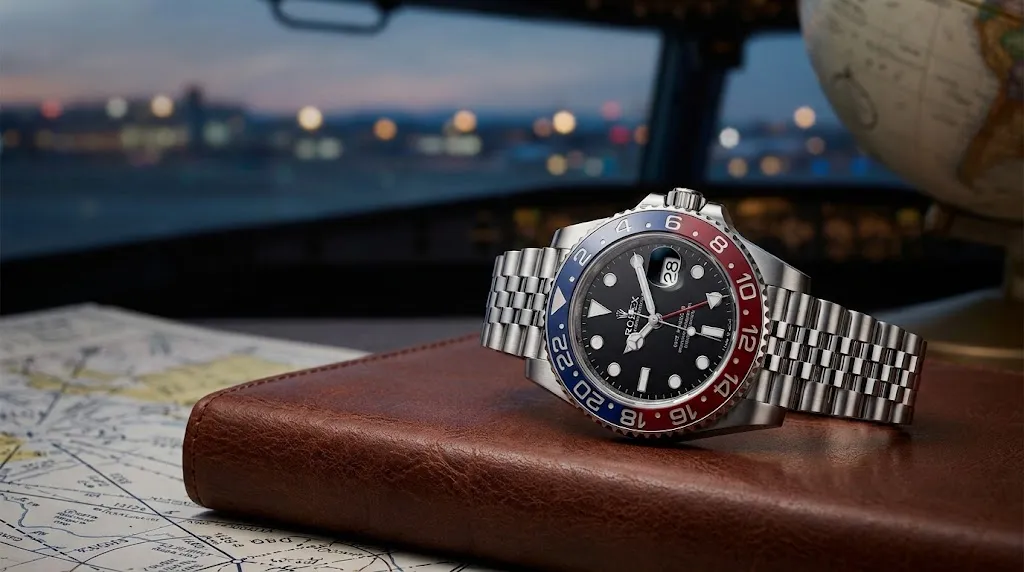
Rolex GMT-Master II: Developed for airline pilots in the 1950s, the GMT-Master II is instantly recognisable by its two-tone “Pepsi” or “Batman” bezels, allowing for the tracking of three time zones simultaneously. It features Rolex’s robust in-house Calibre 3285, offering exceptional accuracy and reliability. The GMT-Master II is a sophisticated travel companion, exuding an air of global adventure and refined utility, highly sought after by collectors for its iconic design and practicality.
Tudor Black Bay GMT: Tudor’s take on the travel watch, building on the success of the Black Bay line. It features a striking “Pepsi” (blue and red) bezel, a slightly thicker case than its dive watch counterpart, and Tudor’s in-house MT5652 GMT calibre with a true jumping hour hand, mirroring the functionality of the Rolex GMT-Master II. It maintains the Black Bay’s robust aesthetic, offering a compelling and well-executed travel watch at a significantly lower price point, making it a favourite among enthusiasts.
Comparison: Both offer true GMT functionality with the jumping hour hand. The Rolex is the original, the ultimate luxury travel watch with unparalleled brand recognition. The Tudor provides an outstanding, more rugged alternative that delivers almost identical functionality and excellent craftsmanship at a fraction of the cost, making it an incredible value proposition.
The Chronographs: Daytona vs. Black Bay Chrono
Rolex Daytona: The legendary chronograph, forever associated with motorsport and Paul Newman. It’s a masterclass in elegant, functional design, powered by Rolex’s in-house Calibre 4130, one of the finest integrated chronograph movements in the world. The Daytona is exceptionally refined, with a symmetrical dial, screw-down pushers, and a sleek profile. It’s notoriously difficult to acquire at retail and holds its value phenomenally, making it one of the most desirable watches globally.
Tudor Black Bay Chrono: Tudor’s modern chronograph, often offered in a “panda” or “reverse panda” dial configuration and featuring the signature Black Bay aesthetic. It’s powered by the MT5813 chronograph movement, which is a modified Breitling B01 calibre (a truly excellent, robust column-wheel chronograph movement). While not entirely in-house, Tudor significantly modifies and finishes it to their own standards. The Black Bay Chrono is bolder, thicker, and more overtly sporty than the Daytona, with a more pronounced vintage feel.
Comparison: The Daytona is the ultimate luxury racing chronograph, an icon of refinement and exclusivity. The Black Bay Chrono is a robust, tool-oriented chronograph with a strong vintage aesthetic, offering fantastic performance and value. It’s a more muscular, everyday-wearable chronograph that stands distinctly apart from its Rolex cousin.
The Dress Watches: Datejust vs. 1926/Royal
Rolex Datejust: The archetype of the classic dress-sport watch. Introduced in 1945, it was the first self-winding chronometer wristwatch to display the date in a window on the dial. Available in a vast array of sizes, materials, bezels (smooth, fluted), and dials, the Datejust is incredibly versatile, equally at home with a suit or casual attire. It’s an elegant, refined watch that embodies timeless sophistication and everyday practicality.
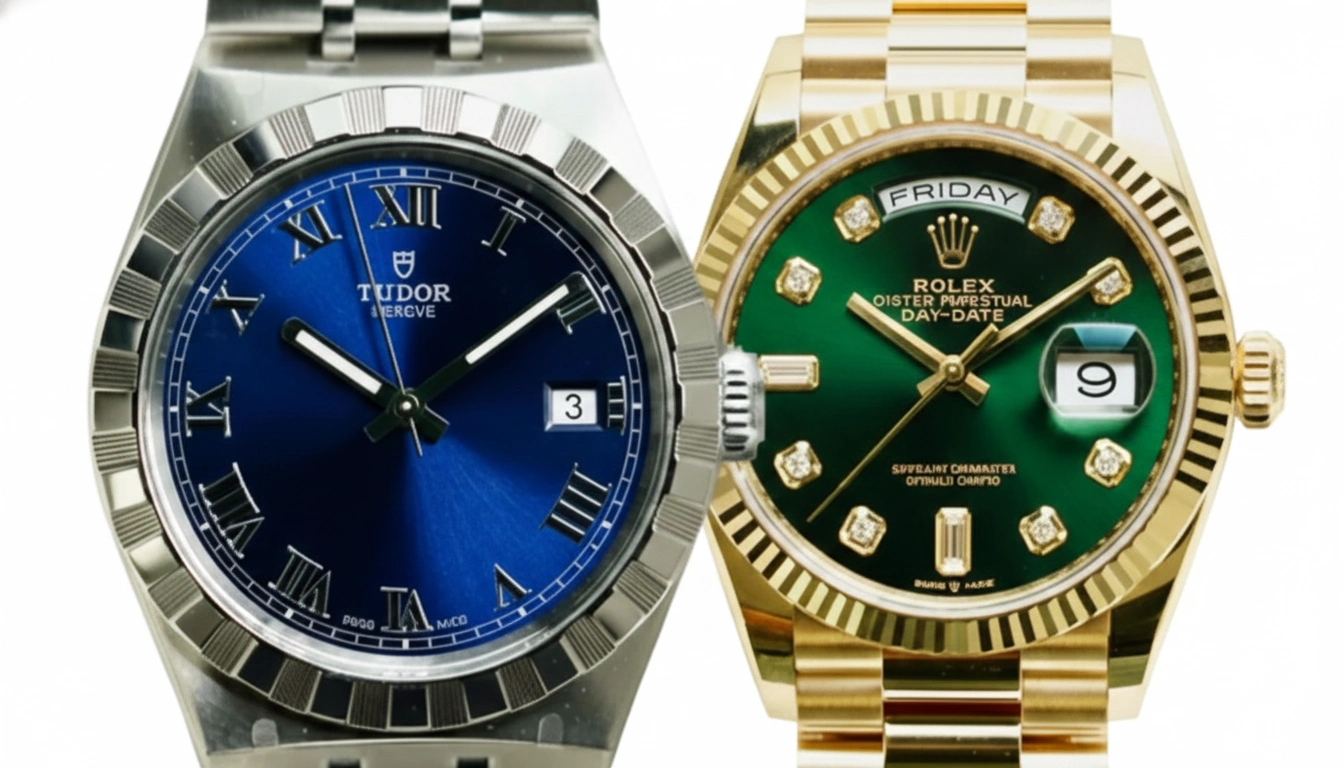
Tudor 1926/Royal: Tudor offers a few lines that lean into the dress watch category. The 1926 collection is a pure vintage-inspired dress watch, named after the year Tudor was registered. It features elegant Arabic numerals, a subtle waffle-patterned dial, and a polished bezel, powered by a reliable ETA movement. The Royal line, re-introduced in 2020, offers an integrated bracelet design with a more contemporary feel, often featuring a notched bezel and Roman numerals, powered by ETA movements. Both are elegant and offer a more accessible entry into a sophisticated daily wearer.
Comparison: The Datejust is the undisputed, iconic classic, a symbol of enduring elegance and versatility, with in-house movements and a strong legacy. Tudor’s dress watch offerings are more understated and accessible, relying on reliable third-party movements and providing a stylish, quality option for those seeking a traditional or contemporary dress watch without the Rolex premium.
Who is a Rolex For?
Understanding the target audience helps solidify the brand’s identity. A Rolex isn’t just a watch; it’s a statement, a reflection of certain aspirations and values.
The Traditionalist
For those who appreciate classic design that transcends trends, who value a brand with an unparalleled history of innovation and uncompromising quality, Rolex is the natural choice. They seek an object of timeless beauty and enduring functionality, a watch that feels as relevant today as it did 50 years ago. The traditionalist values heritage, proven reliability, and the certainty of a globally recognised icon.
The Investor
While not a financial instrument, Rolex watches, particularly popular stainless steel sports models, have demonstrated remarkable resilience and appreciation in value. The “investor” buyer sees not just a beautiful timepiece, but a tangible asset that can hold or even increase its worth over time. They understand the dynamics of supply and demand, brand equity, and the long-term desirability that makes Rolex a relatively safe luxury purchase.
The Status Seeker
Let’s be frank: for many, a Rolex is the ultimate symbol of success and achievement. It’s a discreet yet powerful indicator of accomplishment, a reward for reaching personal or professional milestones. The status seeker desires the recognition and prestige that comes with wearing the “Crown,” enjoying the quiet confidence and universal admiration that a Rolex often elicits. It’s about signalling one’s position and celebrating success in a tangible, elegant way.
Who is a Tudor For?
Tudor caters to a slightly different, though equally discerning, clientele. It’s about substance, adventure, and a more personal connection to horology.
The Enthusiast
The watch enthusiast, someone who dives deep into movements, brand history, and design nuances, often finds a spiritual home with Tudor. They appreciate the in-house calibres, the clever nods to vintage designs, and the brand’s willingness to experiment. The enthusiast values the “bang for buck” ratio, recognising the incredible quality and horological merit that Tudor offers at its price point. They enjoy the subtle nod of recognition from fellow collectors.
The Value Seeker
For those who demand uncompromising quality, robust construction, and a strong horological pedigree without the significant premium of a Rolex, Tudor is an unbeatable proposition. The value seeker is smart with their money, understanding that Tudor delivers an exceptional product that stands shoulder-to-shoulder with much more expensive brands in terms of build quality and movement technology. They seek accessible luxury that feels substantial and performs flawlessly.
The Adventurous Spirit
Tudor has meticulously cultivated an image of rugged capability and a connection to exploration. From its historical associations with military divers to its modern partnerships, Tudor appeals to those with an adventurous spirit. Whether it’s the professional diver who needs a Pelagos for deep dives, the casual adventurer who enjoys the Black Bay’s robust build, or someone who simply appreciates a watch that feels ready for anything, Tudor embodies that spirit of exploration and resilience. It’s a watch designed to be worn, used, and to accompany you on life’s adventures, big or small.
Making Your Decision: Beyond the Wrist
Choosing between Tudor and Rolex is a deeply personal journey, extending beyond mere specifications. It involves introspection about your lifestyle, your values, and your long-term aspirations. Don’t rush this decision; let it be a thoughtful process.
Consider Your Lifestyle
Are you someone who frequents black-tie events and boardrooms, where a Rolex’s undeniable prestige would feel right at home? Or are you more at ease exploring hiking trails, diving into the ocean, or simply navigating the daily grind with a robust, understated companion? Think about how the watch will integrate into your daily life. A Rolex often feels more precious, perhaps reserved for special occasions by some, while a Tudor often invites more adventurous, everyday wear due to its robust nature and slightly less “precious” price tag. Which brand’s ethos aligns more closely with the life you lead and the image you wish to project?
Define Your Budget
This is often the most practical filter. Rolex occupies the upper echelons of luxury pricing, while Tudor offers a fantastic entry point into high-quality Swiss watchmaking. Be honest with yourself about what you are comfortable spending. Remember that beyond the initial purchase, there are servicing costs (though both brands offer excellent long-term service). If a Rolex stretches your budget to an uncomfortable degree, a Tudor might provide the same emotional satisfaction and horological quality without the financial strain. Conversely, if you’ve always dreamt of a Rolex and are in a position to acquire one, the joy of fulfilling that dream is immeasurable.
Think About Long-Term Ownership
Are you planning to wear this watch for decades, perhaps passing it down to the next generation? Both brands offer exceptional longevity and can certainly become treasured heirlooms. However, consider the emotional connection. Do you envision a watch that retains maximum resale value, or one that develops a unique patina from years of adventure? Do you want a watch that subtly signals a certain status, or one that quietly speaks to your appreciation for craftsmanship and a personal journey? Long-term ownership is also about serviceability and parts availability, which both brands excel at, ensuring your timepiece can be cherished for generations.
The Verdict: Which Crown Will You Choose?
Ultimately, the choice between Tudor and Rolex is not about one being definitively “better” than the other. It’s about finding the watch that resonates most deeply with you.
Choose Rolex if you seek the pinnacle of luxury, an undisputed symbol of success and timeless design, unconcerned by the premium price. You value tradition, unwavering precision, and the unique prestige that only the “Crown” can offer. You want an icon, a benchmark of horological excellence that will be recognised and admired universally.
Choose Tudor if you appreciate exceptional craftsmanship, robust in-house movements, and innovative design with a strong vintage appeal, all at a more accessible price point. You are the savvy enthusiast, the adventurer, the individual who values substance and character, and who enjoys a touch of individuality without sacrificing quality or heritage. You want a watch that’s built for purpose, brimming with personality, and speaks to those in the know.
Both brands offer an extraordinary experience on the wrist, a testament to Hans Wilsdorf’s enduring vision. Whichever crown you choose, you’re acquiring a piece of horological history, a reliable companion, and a beautifully engineered object that will mark time for years to come. The right choice isn’t found in a definitive ranking, but in the reflection of your own wrist, and the story you want your watch to tell.Ready to find your perfect timepiece? Explore premium Rolex, Tudor, and other Swiss watches at Swiss Watch Dealer and discover your next classic today.