When you hear the word “Rolex”, your mind likely jumps to a very specific image. Perhaps it is a rugged diver’s watch surfacing from the deep, a sleek chronograph tied to the world of motorsport, or a gold timepiece peeking from beneath the cuff of a powerful public figure. This is no accident. Rolex does not simply manufacture watches; it has built one of the most recognisable legacies in luxury watchmaking.
For beginners entering the world of Rolex, the catalogue can feel both exciting and overwhelming. You are not just looking for a way to tell time; your smartphone already does that with precision. You are looking for a piece of mechanical craftsmanship, design history and personal symbolism.
In this guide, we explore seven of the most iconic Rolex watches of all time. These are the models that helped define the brand, shaped the wider watch industry and continue to influence collectors, enthusiasts and first-time buyers around the world.
Key Highlights
- The Rolex Submariner, Daytona, Datejust, GMT-Master, Day-Date, Explorer and Oyster Perpetual are among the brand’s most recognisable models.
- Each watch became iconic for a different reason, from diving and motorsport to aviation, exploration and formal luxury.
- Rolex watches are valued not only for their design, but also for their history, durability, mechanical quality and market demand.
- Australian buyers should consider authenticity, condition, service history, provenance, box and papers, and the reputation of the seller.
- While some Rolex models have performed strongly on the secondary market, prices can fluctuate, so buyers should choose a watch they genuinely appreciate.
The Crown’s Legacy: Why Certain Rolex Models Become Icons
To understand why Rolex commands such reverence, you have to look beyond the steel, gold and sapphire crystal. Many brands make high-quality watches, but few have managed to connect their timepieces so closely with human achievement, cultural status and everyday aspiration.
Beyond Timekeeping: The Rolex Mythos
The Rolex story is built on performance, visibility and carefully crafted legacy. Founder Hans Wilsdorf understood that a watch needed to prove itself outside the showroom. It had to survive real-world conditions, be seen on extraordinary wrists and become associated with achievement.
Rolex watches have been linked to major moments in sport, exploration, aviation, diving and popular culture. This creates a powerful psychological connection. When someone wears a Rolex, they are not simply wearing a mechanical object. They are wearing a symbol associated with precision, ambition and endurance.
That is the strength of the Rolex mythos. The watches are not just admired because they are expensive; they are admired because they feel meaningful.
Our Criteria for “Iconic” Status
The word “iconic” is often used too casually in watch collecting. For this list, a model needs to meet three key standards:
Historical impact:
Did the watch introduce, popularise or perfect a design or function that influenced the industry?
Visual continuity:
Can the watch be recognised across generations? An icon should maintain its core identity over decades.
Collector relevance:
Does the model still drive conversation among enthusiasts, collectors and luxury watch buyers?
With those criteria in mind, here are the seven Rolex models that stand above the rest.
1. Rolex Submariner
If someone were asked to picture a luxury sports watch, there is a good chance they would imagine something very close to the Rolex Submariner. Introduced in 1953, the Submariner was not the only early dive watch, but it became the model that defined the category.
It turned the wristwatch into a robust underwater instrument while also becoming one of the most versatile luxury watches ever made.
A Tool for the Deep and the Boardroom
The Submariner was originally designed for divers. Its rotating bezel allowed wearers to track elapsed time underwater, while its highly legible dial, strong case and Oyster bracelet made it practical in demanding conditions.
Then something remarkable happened. The Submariner moved beyond its tool-watch origins and became a cultural object. Its association with James Bond in the 1960s helped show that a rugged dive watch could also be worn with a suit.
That duality remains central to the Submariner’s appeal. It is sporty without being casual, refined without being delicate and recognisable without needing explanation. For many collectors, it is the ultimate one-watch collection.
Key Milestones: From Early References to Green Bezels
The Submariner has evolved steadily while preserving its core DNA. Early models had slimmer cases and no crown guards, making them especially desirable to vintage collectors. Later references improved water resistance, movement performance, bracelet construction and bezel materials.
Some of the most famous Submariner variations include:
The Kermit:
The 50th anniversary Submariner with a green bezel and black dial.
The Hulk:
A bold green-bezel, green-dial Submariner that became one of the most talked-about modern Rolex sports watches.
The modern Submariner:
Current-generation models feature refined proportions, robust movements and ceramic bezels designed for long-term durability.
Throughout these changes, the Submariner has remained instantly recognisable.
Why It Remains So Influential
Many dive watches borrow from the Submariner’s formula: round case, rotating bezel, luminous markers, Oyster-style bracelet and clean dial layout. Yet the Submariner remains the reference point.
It is not simply a popular Rolex. It is one of the most influential watch designs ever made.
2. Rolex Cosmograph Daytona
The Rolex Cosmograph Daytona has one of the most fascinating stories in watch collecting. Today, it is one of the most sought-after watches in the world. Yet when it was first released in the 1960s, it was not an immediate commercial success.
Its busy chronograph dial and racing-focused design were more specialised than the cleaner Submariner or Datejust. Over time, however, that specialisation became its strength.
The Paul Newman Effect
The Daytona’s collector status changed dramatically thanks to Paul Newman. The actor and racing enthusiast famously wore a Daytona with an exotic dial, later nicknamed the “Paul Newman” dial by collectors.
His personal watch eventually became one of the most famous wristwatches ever sold at auction, helping cement the Daytona’s place at the top of the collector world.
The lesson is simple: provenance matters. A great watch can become legendary when it is connected to the right person, story and moment in history.
Built for the Track
The Daytona was designed as a motorsport chronograph. Its tachymeter scale allows drivers to calculate average speed over a measured distance, while the chronograph pushers and sub-dials measure elapsed time.
Over the decades, the Daytona has used different movement architectures, including manually wound movements, modified automatic chronograph movements and Rolex’s own in-house chronograph calibres.
Its design has also remained remarkably consistent: three sub-dials, strong case proportions, a sporty bracelet and a dial layout that feels technical yet balanced.
The Modern Cult of the Panda Dial
Modern stainless steel Daytona models, especially white-dial versions often called “Panda” dials, are among the hardest Rolex watches to obtain through retail channels. Demand remains high because the Daytona combines sport, celebrity, scarcity and technical credibility.
For many collectors, the Daytona is not just a chronograph. It is the ultimate expression of Rolex desirability.
3. Rolex Datejust
While the Submariner and Daytona represent Rolex’s professional sports-watch identity, the Datejust represents the heart of the brand. It is elegant, versatile and instantly recognisable.
Released in 1945, the Datejust helped define what a modern luxury wristwatch could be. It combined automatic winding, water-resistant Oyster case construction and a practical date display into a watch suitable for almost any occasion.
A Landmark in Everyday Watch Design
The Datejust was one of the first automatic wristwatches to feature a date window on the dial. The later addition of the Cyclops magnifying lens made the date easier to read and became one of Rolex’s signature visual elements.
Today, the Datejust still feels familiar because so many watches have followed its formula. It is the classic daily luxury watch: practical, polished and enduring.
The Jubilee Bracelet and Fluted Bezel
Two of the Datejust’s most famous design elements are the Jubilee bracelet and the fluted bezel.
The Jubilee bracelet was introduced with the Datejust and remains one of Rolex’s most comfortable and elegant bracelet designs. Its five-link construction gives it a dressier appearance than the sportier Oyster bracelet.
The fluted bezel was once functional, helping secure the bezel to the case. Over time, it became a decorative Rolex signature, especially when crafted in gold.
Together, these features give the Datejust its unmistakable identity.
Versatility Across Generations
The Datejust is available in a wide range of sizes, metals, dials and bracelet combinations. It can be understated in stainless steel, traditional in two-tone Rolesor or luxurious in precious metal with diamond markers.
This versatility explains why the Datejust appeals to such a broad audience. It can be a first Rolex, a professional milestone, a wedding gift or a family heirloom.
Few watches age as gracefully.
4. The Rolex GMT-Master: The Traveller’s Ultimate Companion
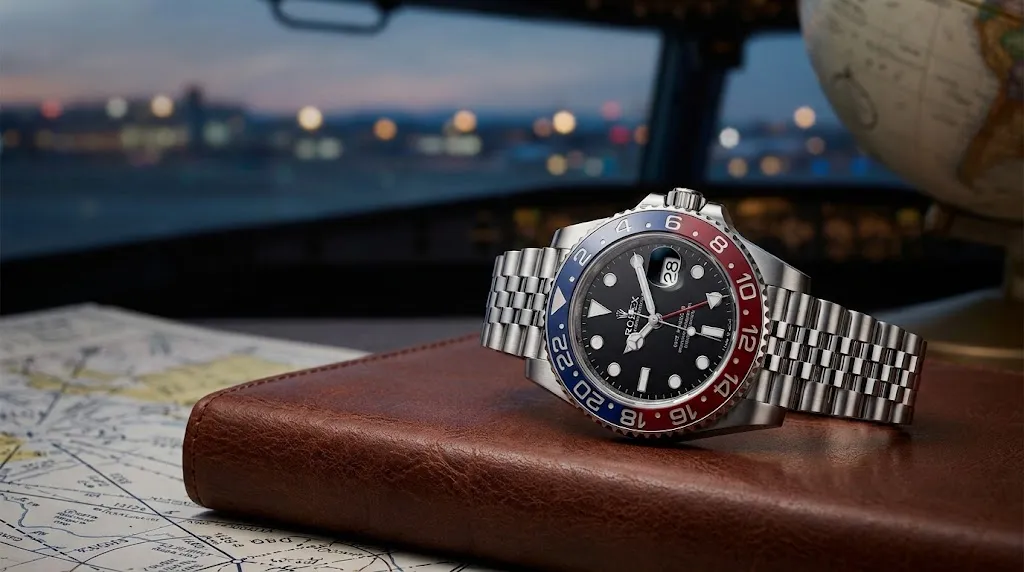
The GMT-Master was born in the jet age. As international air travel expanded in the 1950s, pilots needed a practical way to track more than one time zone. Rolex developed the GMT-Master in partnership with aviation needs, and the result became one of the most iconic travel watches ever made.
Pan Am and the Jet Age
The original GMT-Master was closely associated with Pan American World Airways. It featured an additional 24-hour hand and a rotating bezel, allowing pilots to track both local time and a reference time such as Greenwich Mean Time.
This made the watch genuinely useful for long-haul aviation. It was not just a luxury accessory; it was a professional instrument for a shrinking world.
Pepsi, Coke, Batman and Root Beer
The GMT-Master and GMT-Master II are famous for their bi-colour bezels. These colour combinations were originally practical, helping distinguish day from night on the 24-hour scale. Over time, they became collector nicknames.
Famous variations include:
Pepsi:
Red and blue bezel.
Coke:
Red and black bezel.
Batman:
Blue and black bezel.
Root Beer:
Brown, gold or black tones, depending on the reference.
These nicknames are now part of the Rolex collector language and have helped turn the GMT-Master into a cultural icon.
A Practical Complication for Modern Life
Unlike some watch complications that are admired more than used, a GMT function remains genuinely practical. It is useful for international travellers, remote workers, business owners, collectors buying overseas and anyone with family or colleagues in another time zone.
For Australian buyers who frequently deal with Europe, Asia or the United States, the GMT-Master is not only beautiful. It is genuinely useful.
5. The Rolex Day-Date: The President’s Watch
If the Datejust is the watch of everyday success, the Day-Date is the watch of arrival. Introduced in 1956, it was the first Rolex wristwatch to display both the date and the day of the week written in full.
The Day-Date has long been associated with leadership, wealth and influence. It is one of the clearest status symbols in the Rolex catalogue.
Only in Precious Metals
One of the Day-Date’s defining features is that it is not made in stainless steel. Rolex produces the Day-Date only in precious metals such as gold and platinum.
This immediately places it in a different category from many other Rolex models. A Day-Date is not trying to be an understated tool watch. It is a luxury statement.
Power, Prestige and the President Bracelet
The Day-Date is often called the “President” because of its association with political leaders and high-profile figures. The nickname is also tied to the President bracelet, a three-link bracelet design created specifically for the model.
With its precious metal case, fluted or smooth bezel, full day display and distinctive bracelet, the Day-Date communicates authority in a way few watches can.
Dial Variations and Personality
Rolex has produced the Day-Date with an impressive range of dials, including stone dials, diamond-set dials, sunburst finishes and day wheels in different languages.
This allows the model to move from traditional to extravagant. A yellow gold Day-Date with champagne dial is pure classic Rolex, while a platinum version with an ice-blue dial feels cooler and more contemporary.
The Day-Date is not just about telling time. It is about presence.
6. The Rolex Explorer: A Tribute to Human Achievement
The Rolex Explorer is one of the most understated watches in the Rolex line-up, yet its history gives it enormous significance. Where the Daytona belongs to the racetrack and the Submariner belongs to the sea, the Explorer belongs to the mountain.
It is a watch associated with endurance, clarity and exploration.
The Everest Connection
The Explorer was inspired by Rolex’s connection to high-altitude exploration and the 1953 Everest expedition. Rolex used that association to create a watch built around legibility, robustness and simplicity.
The result was the Explorer I, a watch with no rotating bezel, no chronograph, no date window and no unnecessary decoration. Its famous 3-6-9 dial became a symbol of functional watch design.
The Beauty of Minimalism
The Explorer’s strength lies in its restraint. It does not need precious metal, bright colours or complicated functions to be compelling. Its appeal is based on proportion, legibility and purpose.
For many enthusiasts, the Explorer is one of the purest Rolex watches. It is a watch for people who want the quality and history of Rolex without the obvious flash.
The Explorer II: Built for Darkness and Distance
In 1971, Rolex expanded the Explorer family with the Explorer II. Designed with cave explorers and adventurers in mind, it featured a fixed 24-hour bezel and an additional 24-hour hand.
This allowed wearers to distinguish day from night in environments where sunlight was absent. Over time, the Explorer II became popular with collectors who wanted a more rugged and distinctive alternative to the GMT-Master.
The Explorer line proves that Rolex does not need extravagance to create an icon.
7. The Rolex Oyster Perpetual: The Purest Expression of Rolex
The Oyster Perpetual is sometimes described as the entry point into Rolex ownership, but that label does not fully capture its importance. In many ways, it is the purest expression of the brand.
The name itself tells the story. “Oyster” refers to Rolex’s waterproof case design, while “Perpetual” refers to the self-winding movement. Together, these two innovations form the foundation of modern Rolex watchmaking.
The Foundation of the Rolex Identity
The Oyster Perpetual strips the Rolex formula back to its essentials: strong case, automatic movement, clean dial, robust bracelet and timeless proportions.
There is no date window, no rotating bezel, no chronograph and no dual-time complication. What remains is the core Rolex experience.
That simplicity is exactly why the watch has such lasting appeal.
More Than an Entry-Level Rolex
For years, the Oyster Perpetual was viewed as a conservative and accessible Rolex option. It was often chosen for graduations, promotions and first luxury watch purchases.
However, its reputation has grown significantly. Collectors increasingly appreciate its clean design, excellent wearability and direct connection to Rolex history.
An Oyster Perpetual may be simple, but it is far from ordinary.
A Modern Canvas for Colour
In recent years, colourful Oyster Perpetual dials have brought renewed attention to the model. Bright dial colours gave the watch a more playful and contemporary personality, attracting younger buyers and collectors who wanted something different from traditional black, silver or blue.
This proved that even Rolex’s simplest model can still create excitement.
What Makes a Rolex a Worthwhile Purchase?
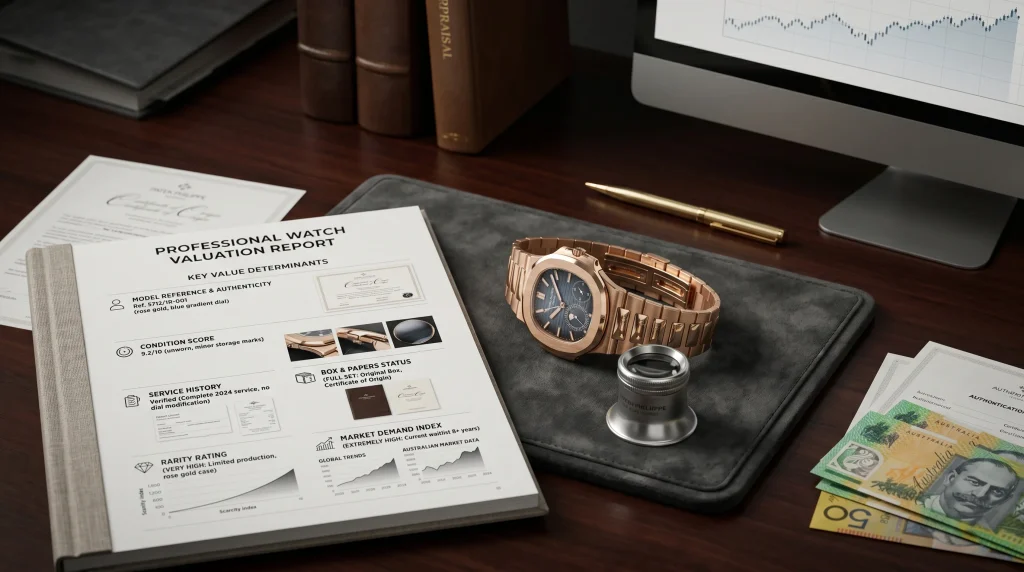
Rolex watches are often discussed in investment terms, but buyers should approach that topic carefully. While some models have historically performed strongly on the secondary market, values can rise or fall depending on demand, condition, rarity, documentation, service history and wider market conditions.
The best reason to buy a Rolex is because you appreciate the watch itself.
Secondary-Market Demand
Rolex enjoys unusually strong demand in the pre-owned luxury watch market. Some stainless steel sports models, such as certain Submariner, Daytona and GMT-Master references, may trade above original retail prices depending on availability and market conditions.
However, not every Rolex appreciates in value, and past performance does not guarantee future results. Buyers should avoid treating any watch as a risk-free financial product.
A more balanced way to think about Rolex is this: it is a luxury item with unusually strong brand equity, high liquidity compared with many other watches and enduring global recognition.
Mechanical Quality and Longevity
Part of Rolex’s appeal comes from its durability. The brand is known for robust case construction, reliable automatic movements, strong bracelets and high standards of accuracy.
A well-maintained Rolex can last for decades and, in many cases, be passed down to the next generation. This long lifespan supports both its emotional value and its secondary-market desirability.
When you buy a Rolex, you are not simply buying a fashion accessory. You are buying a mechanical object designed for long-term use.
How to Start Your Own Rolex Collection
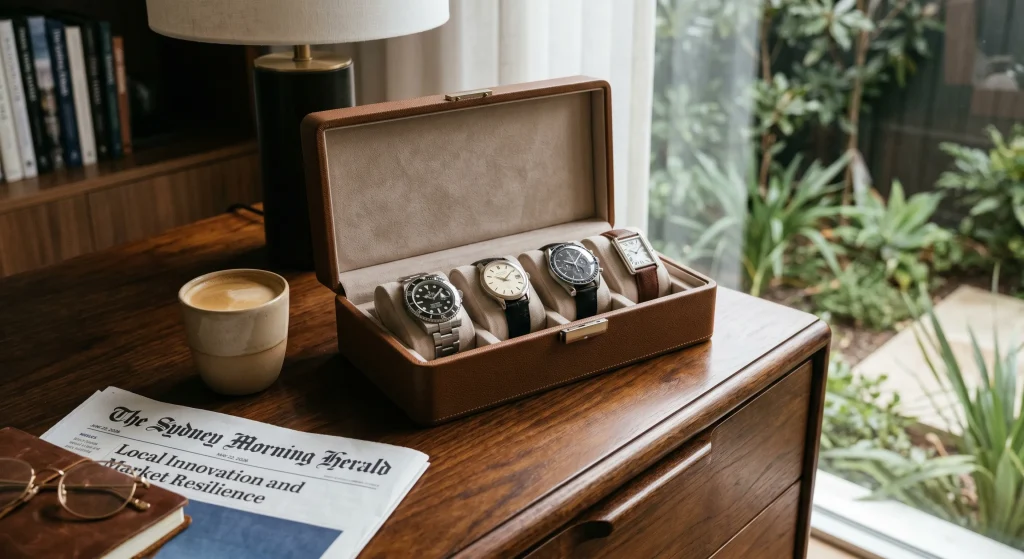
If you are ready to move from admirer to owner, it helps to approach the market with a clear strategy. Rolex collecting can be rewarding, but it also requires caution, especially when buying pre-owned or vintage pieces.
New vs Pre-Owned
Buying new gives you the confidence of being the first owner, along with current-generation materials, manufacturer warranty and the full retail experience. The challenge is availability. Many popular Rolex models are difficult to access at authorised retailers.
Buying pre-owned gives you access to discontinued references, vintage models, rare dial variants and watches that may not be available through retail channels. The challenge is ensuring authenticity, condition and fair pricing.
For many Australian buyers, the pre-owned market is the most practical way to find specific Rolex models without long waiting periods.
The Importance of Authenticity, Box and Papers
In the Rolex world, provenance matters. A watch with its original box, warranty card, booklets and purchase documents will often be more desirable than a watch without them.
These items are commonly referred to as “box and papers”. They are not the only proof of value, but they help support authenticity and ownership history.
When buying pre-owned, always consider:
- Is the watch authentic?
- Are the case, dial, hands, bracelet and movement correct for the reference?
- Has the watch been polished heavily?
- Does it come with box and papers?
- Is there service history?
- Is the seller reputable?
- Is there a warranty or return policy?
The old collecting advice still applies: buy the seller before you buy the watch.
Servicing and Long-Term Care
A Rolex is a mechanical instrument and should be maintained properly. Service intervals depend on the model, age, condition and usage, but periodic servicing helps preserve performance and water resistance.
Owners should also be mindful of water exposure, magnetic fields, heavy impacts and improper polishing. A Rolex is built to be worn, but thoughtful care will help protect its condition over the long term.
For collectors, condition is everything. A well-preserved watch with original parts can be significantly more desirable than one that has been over-polished or poorly repaired.
Final Thoughts: Which Rolex Icon Defines Your Journey?
Choosing a Rolex is a personal decision. Are you drawn to the underwater utility of the Submariner, the motorsport heritage of the Daytona, the everyday elegance of the Datejust or the global practicality of the GMT-Master?
Perhaps the prestige of the Day-Date speaks to you. Maybe the understated toughness of the Explorer feels more authentic. Or maybe the clean simplicity of the Oyster Perpetual is exactly what you want from a first Rolex.
There is no single right answer. Each of these models has earned its place through decades of design continuity, technical refinement and cultural relevance.
A Rolex is not just a way to check the time. It is a symbol of craftsmanship, achievement and personal taste. More importantly, it is a watch that carries a story.
The real question is: which story do you want on your wrist?
Looking for your next Rolex in Australia? Explore authentic new and pre-owned luxury watches with Swiss Watch Dealer, a trusted destination for collectors seeking quality, provenance and expert guidance.