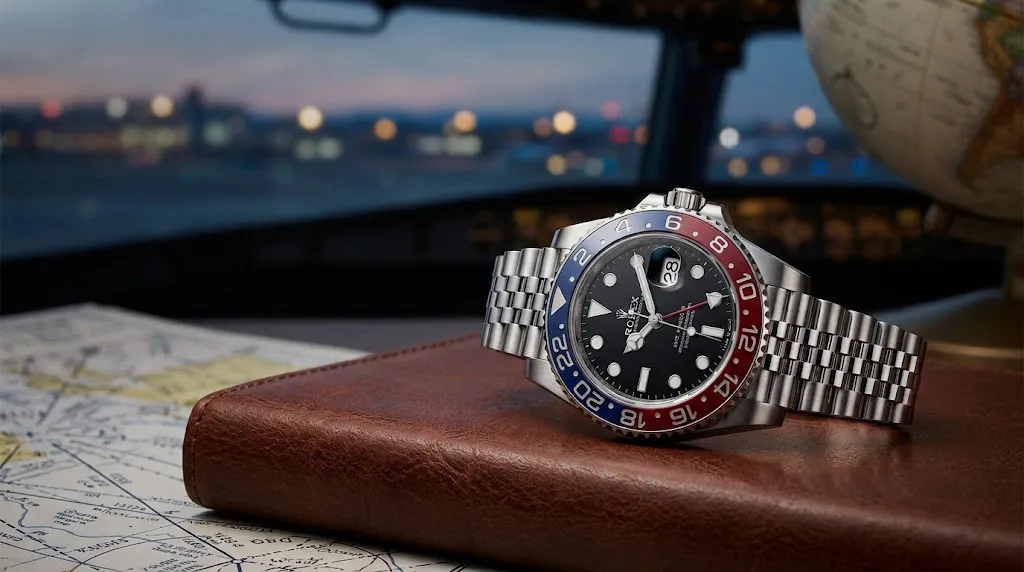
Few Rolex watches are as recognisable as the Rolex Pepsi. Its red and blue bezel has been linked with international travel for decades, evolving from a functional pilots’ watch into one of Rolex’s best-known sports-watch designs.
Today, Rolex Pepsi usually refers to GMT-Master and Rolex GMT-Master II Pepsi models fitted with the familiar red and blue 24-hour bezel. The best-known modern reference is the stainless steel 126710BLRO, although the Pepsi story began more than 70 years ago.
If you are comparing references or considering buying one in Australia, this guide covers the key models, vintage and modern differences, bracelets, bezels and what to check before purchasing.
You can also browse Rolex watches currently available from Swiss Watch Dealer.
What Is a Rolex Pepsi?
“Pepsi” is an unofficial collector nickname for Rolex GMT watches with a red and blue bezel.
The two colours originally had a practical purpose. Used with the GMT hand and 24-hour scale, the bezel helped wearers distinguish different parts of the day while following another time zone.
According to Rolex’s history of the GMT-Master, the watch was developed during the expansion of international air travel and was used by Pan American World Airways pilots.
Modern GMT-Master II watches retain the same travel-focused idea. They can display local time and a second time zone, while the rotating 24-hour bezel provides additional flexibility when travelling.
Rolex Pepsi Reference Timeline
The main references worth knowing are:
ReferenceApproximate eraKey featuresBezel65421950sOriginal GMT-Master, no crown guardsBakelite, later metal16751959–1980Crown guards, long production runAluminium167501980sQuickset date, updated movementAluminium16700Late 1980s–1990sSapphire crystal, later GMT-MasterAluminium167101989–2000sIndependent local hour adjustmentAluminium116719BLROFrom 2014First ceramic Pepsi, white goldCerachrom126710BLROFrom 2018Modern Oystersteel PepsiCerachrom126719BLROModern generationWhite gold versionsCerachrom
A broader overview of the model’s development is available in the history of the Rolex GMT-Master.
Ref. 6542 and 1675: The Early Rolex Pepsi
The Reference 6542 established the GMT-Master design in the 1950s.
Unlike later Rolex sports watches, it had no prominent crown guards. Early examples are especially recognisable for their Bakelite bezels, although replacement components are common on watches of this age.
The Reference 1675 followed in 1959 and remained in production for roughly two decades. It introduced crown guards and appeared with several dial variations, including gilt and later matte dials.
For vintage buyers, originality matters. The dial, hands, bezel insert, case condition and service history can all affect collectability and value.
The 1675 also has a notable place in popular culture. A GMT-Master worn by Marlon Brando in Apocalypse Now later attracted significant attention at auction, as reported by Forbes.
Ref. 16750, 16700 and 16710
Reference 16750 introduced a quickset date, making everyday adjustment easier than on earlier GMT-Master models.
The later 16700 moved closer to modern Rolex construction with features such as a sapphire crystal, but it still belonged to the original GMT-Master family.
The 16710 is particularly popular with buyers who want vintage character without going as far back as the earliest references.
Its aluminium Pepsi bezel provides the traditional appearance of older GMT watches, while its GMT-Master II movement allows the local hour hand to be adjusted independently.
That makes the GMT function more convenient when travelling because local time can be changed without disturbing the reference time.
The 16710 is also slimmer and visually lighter than today’s ceramic models, giving it a more traditional tool-watch feel.
Ref. 116719BLRO: The First Ceramic Pepsi
The Pepsi colour scheme returned in ceramic with the 116719BLRO in 2014.
This model introduced Rolex’s red and blue Cerachrom bezel, which offers much stronger resistance to scratching and fading than older aluminium inserts.
Unlike earlier steel Pepsi models, the 116719BLRO was produced in white gold, giving it a heavier and more luxurious character.
Its introduction marked the transition between the traditional aluminium Pepsi and the modern ceramic generation.
Ref. 126710BLRO: The Modern Rolex Pepsi
In 2018, Rolex introduced the Ref. 126710BLRO in Oystersteel.
For many buyers today, this is the model they mean when searching for a Rolex Pepsi.
Key specifications include:
- 40 mm Oystersteel case
- Red and blue Cerachrom bezel
- Black dial
- Sapphire crystal
- Calibre 3285 automatic movement
- Approximately 70-hour power reserve
- Independent local hour adjustment
- Second time zone display
- Jubilee or Oyster bracelet options
The return to stainless steel made the 126710BLRO especially appealing to buyers who wanted the classic Pepsi colour combination with modern Rolex construction.
Swiss Watch Dealer currently lists Pepsi references within its Rolex GMT-Master II collection.
Rolex Pepsi Jubilee vs Oyster Bracelet
Modern Rolex Pepsi buyers may encounter both Jubilee bracelet and Oyster bracelet configurations.
Neither is automatically better. The choice mainly comes down to appearance and wrist feel.
FeatureJubilee BraceletOyster BraceletConstructionFive-piece linksThree-piece linksAppearanceMore detailed and refinedCleaner and sportierWrist feelFlexibleMore structuredOverall styleClassic luxuryTraditional sports-watch look
The Jubilee gives the Pepsi a slightly dressier appearance, while the Oyster emphasises its sports-watch character.
If possible, try both before buying. Bracelet choice can noticeably change how the watch feels on the wrist.
Aluminium vs Ceramic Pepsi Bezels
One of the biggest differences between vintage and modern Rolex Pepsi models is the bezel material.
Aluminium Bezels
Older references such as the 1675, 16750 and 16710 generally use aluminium inserts.
Over time, exposure and wear may soften or fade the colours. Some collectors appreciate this ageing, but faded colour alone should not be treated as proof of originality or increased value.
Ceramic Bezels
Modern Pepsi models use Rolex’s Cerachrom ceramic bezel.
Ceramic is more resistant to scratches and colour deterioration, giving modern models a sharper and more consistent appearance.
The choice therefore comes down largely to preference: aluminium provides more vintage character, while ceramic offers greater durability.
What Affects the Value of a Rolex Pepsi?
There is no single market price for every Rolex Pepsi.
Value can vary according to:
- Reference number
- Age
- Overall condition
- Original components
- Dial and bezel configuration
- Bracelet condition
- Service history
- Box and documentation
- Current market demand
- Whether the watch is new, unworn or pre-owned
Vintage references require particular attention because replacement dials, hands or bezels can significantly change collector interest.
Modern watches are generally easier to compare because there is less variation between individual examples.
For more detail, see Swiss Watch Dealer’s guide explaining how much a Rolex watch is worth in Australia.
How to Check a Rolex Pepsi Before Buying
Authentication is especially important when purchasing a high-value Rolex.
A watch should be evaluated as a complete piece rather than judged by one detail.
Check the following areas:
- Reference and serial details
Confirm that identifying details are consistent with the watch and its documentation. - Dial and hands
Check printing, alignment, lume and whether the components are appropriate for the reference. - Bezel
Inspect the insert, numerals, colour transition and construction. - Case condition
Look for excessive polishing, unusual proportions or damage around the lugs and crown guards. - Bracelet and clasp
Check construction, markings, wear and fit. - Movement
Professional inspection may be appropriate if authenticity or mechanical condition is uncertain. - Documentation
Boxes, warranty cards and service records can support provenance, although paperwork alone does not prove authenticity.
Swiss Watch Dealer also offers a luxury watch authentication service for buyers who want additional verification.
Vintage vs Modern Rolex Pepsi Models
The right Rolex Pepsi depends on what you want from the watch.
Choose a Vintage Pepsi If You Prefer:
- Aluminium bezels
- Slimmer proportions
- Historical references
- Age-related character
- Collectable dial and bezel variations
Vintage watches usually require more research because originality and service history can have a major effect on value.
Choose a Modern Pepsi If You Prefer:
- Oystersteel construction
- Cerachrom ceramic bezel
- Modern movement technology
- 70-hour power reserve
- Contemporary water resistance
- Jubilee or Oyster bracelet options
- Easier everyday wear
For buyers who simply want the familiar Pepsi appearance with modern construction, the 126710BLRO is usually the most straightforward option.
Buying a Rolex Pepsi in Australia
When buying a Rolex Pepsi through the secondary market, the seller matters almost as much as the watch.
Before purchasing, check:
- Whether the seller has an established business presence
- Authentication procedures
- Watch condition descriptions
- Return policies
- Warranty terms
- Secure payment arrangements
- Insured delivery
- Whether the watch can be inspected before purchase
Australian buyers should also understand their rights when purchasing from a business. The ACCC’s consumer rights and guarantees guidance explains the protections that may apply.
Avoid choosing solely on the lowest advertised price. For high-value watches, condition, authenticity, provenance and after-sales support can be just as important.
Caring for a Rolex Pepsi
Routine care can help preserve the appearance and condition of the watch.
Avoid aggressive chemicals or abrasive products, keep the case and bracelet clean, and consider having the water resistance checked before exposing an older watch to water.
Vintage pieces need additional care because seals, crystals and other components may have aged.
For everyday maintenance advice, see Swiss Watch Dealer’s watch cleaning guide for luxury timepieces.
Keep original boxes, cards, receipts and service records with the watch where possible, as they can help document its history.
Is the Rolex Pepsi Worth Buying?
The Rolex Pepsi combines one of Rolex’s most recognisable colour schemes with the practical GMT-Master design.
Vintage references such as the 1675 and 16710 appeal to collectors who prefer aluminium bezels and traditional proportions. The white gold 116719BLRO introduced the ceramic Pepsi era, while the Oystersteel 126710BLRO offers the classic red and blue appearance in a modern package.
Rather than choosing purely on popularity, consider the reference, bracelet, materials, condition, provenance and how you intend to wear the watch.
If you are ready to compare available examples, explore the current Rolex GMT-Master II collection at Swiss Watch Dealer to view Pepsi and other GMT models available in Australia.